Air conditioning is responsible for 60–70% of the average Dubai household’s electricity consumption during summer. If your DEWA bill climbs past AED 1,000 between May and September every year, your AC is almost certainly the reason — and a thermostat is the single most effective tool to bring that number down without sacrificing comfort. This is not a vague “save energy” guide. Below, we break down exactly how much you’re paying DEWA per kilowatt-hour in 2026, how much a smart thermostat actually saves in dirhams, and which models work with the split-system AC setups that dominate homes across Dubai, Abu Dhabi, and the rest of the UAE.
What DEWA Actually Charges You in 2026 (And Why It Matters)
Before talking about savings, you need to understand what you’re paying. DEWA uses a slab tariff system — the more electricity you consume, the higher the rate per unit. Here are the current residential electricity rates, sourced directly from DEWA’s official slab tariff page:
| Slab | Consumption (kWh/month) | Rate (fils/kWh) | Rate (AED/kWh) |
|---|---|---|---|
| Green | 0 – 2,000 | 23 fils | AED 0.23 |
| Yellow | 2,001 – 4,000 | 28 fils | AED 0.28 |
| Orange | 4,001 – 6,000 | 32 fils | AED 0.32 |
| Red | 6,001+ | 38 fils | AED 0.38 |
On top of these slab rates, DEWA adds a fuel surcharge of 6.0 fils/kWh (as of March 2026), a 5% housing fee on electricity and water charges, and 5% VAT on the total. Here’s why the slab system makes thermostats so valuable: if your monthly consumption is 4,500 kWh (common for a 3-bedroom villa in summer), the first 2,000 kWh cost you 23 fils each, the next 2,000 cost 28 fils, and the remaining 500 kWh cost 32 fils. Every kilowatt-hour you shave off comes from the most expensive slab first. A thermostat that reduces your AC runtime by even 15% doesn’t just save 15% of your electricity cost — it saves 15% at the highest rate you’re paying.
How Much Can a Thermostat Actually Save You? (Real Numbers)
Let’s do the maths with a real scenario. Scenario: 2-bedroom apartment in Dubai, summer month
- Monthly consumption without thermostat schedule: ~3,200 kWh
- AC accounts for roughly 65% of that: ~2,080 kWh just for cooling
- Electricity cost at slab rates + fuel surcharge: approximately AED 980
Independent studies of Nest thermostat users found an average 15% reduction in cooling energy. Ecobee’s internal data showed savings of up to 23% on heating and cooling combined. Even the conservative ENERGY STAR benchmark puts smart thermostat savings at around 8% of total heating and cooling bills. Let’s take a moderate 15% reduction on AC consumption:
- 15% of 2,080 kWh = 312 kWh saved per month
- At blended slab rate (~29 fils/kWh including fuel surcharge): AED 90–110 saved per month
- Over a 5-month Dubai summer (May–September): AED 450–550 saved
- Annual savings including shoulder months: AED 600–800
For villas, the numbers are significantly higher. A 4-bedroom villa consuming 5,500 kWh in summer and hitting the Orange and Red slabs can save AED 200+ per month with proper thermostat scheduling — because those saved units come off the 32 and 38 fils/kWh bands. The Google Nest Learning Thermostat 4th Gen retails for around AED 1,100–1,300 in the UAE. At AED 600–800 in annual savings, you’re looking at a payback period of 18 months or less — and the device lasts years.
Why Thermostats Work So Well in the UAE Specifically
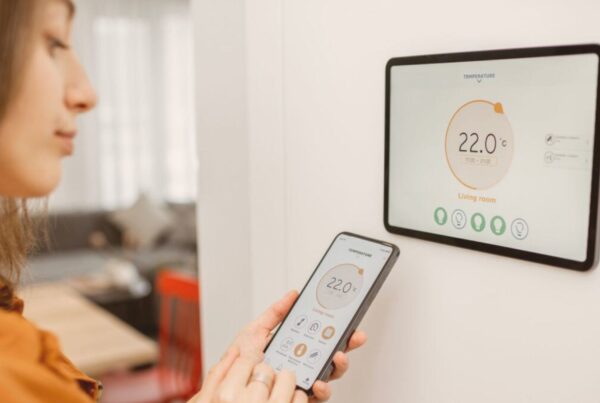
Most global thermostat advice is written for homes with central heating in cold climates. The UAE is a completely different situation, and in many ways, thermostats are even more effective here. Here’s why: AC runs 8–10 months a year. Unlike countries where heating runs 4–5 months, Dubai’s cooling season stretches from April through October — sometimes longer. That means a thermostat has 8–10 months of the year to generate savings, not just a few winter months. The temperature differential is extreme. When it’s 46°C outside and you want 22°C inside, your AC is working incredibly hard. Raising your setpoint from 22°C to 24°C — a difference you’ll barely notice — reduces the cooling load significantly. DEWA themselves recommend 24°C as the optimal setting, and each degree higher saves an estimated 5–8% on cooling costs. UAE homes are often left empty during the day. Many households in Dubai have all adults at work and children at school from 7am to 3pm or later. Running your AC at full blast for 8 hours in an empty apartment is pure waste. A smart thermostat with scheduling or geofencing eliminates this entirely — it raises the temperature while you’re out and cools the home down 30 minutes before you return. Split-system AC dominates. Most UAE homes use split AC units rather than central ducted systems. Products like the Ecobee Smart Thermostat and Google Nest can work with split systems when paired with adapters like the DropAir, which bridges the gap between smart thermostats and conventional AC units common in the region.
Which Thermostat Should You Get for UAE Use?
Not every thermostat is suitable for UAE conditions. Here’s what matters and which models we recommend:
Google Nest Learning Thermostat (4th Gen)
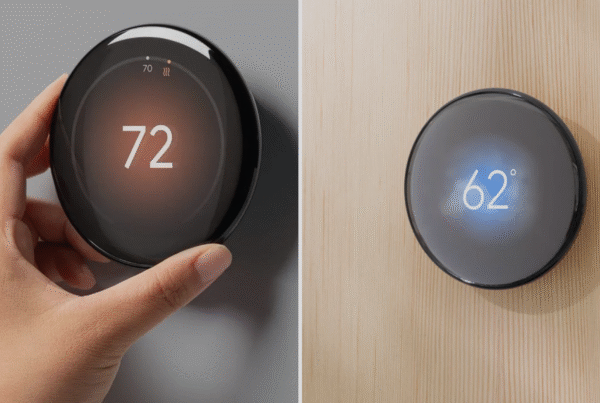
The Nest learns your schedule within a week and builds an automatic temperature programme around your habits. Its Home/Away Assist feature uses your phone’s location to detect when nobody is home and adjusts the temperature accordingly. The companion app gives you monthly energy reports showing exactly how much you’ve used and where savings are happening. For UAE homes, the Nest is particularly effective because its learning algorithm adapts to the extreme cooling patterns we see here — it won’t try to apply a European heating template to your Dubai apartment. Best for: Apartments and villas with ducted AC or DropAir-compatible split systems. View Google Nest Thermostats →
Ecobee Smart Thermostat
Ecobee’s standout feature is its SmartSensor system, which lets you place wireless sensors in different rooms. Instead of measuring temperature at a single hallway thermostat, the Ecobee averages readings from multiple rooms — which is particularly useful in UAE villas where the master bedroom might be 5°C cooler than the upstairs guest room. The built-in HomeIQ energy report is also useful for tracking your actual savings against your DEWA bill. Ecobee claims up to 23% savings for its users, and the room-level monitoring means you’re not overcooling rooms nobody uses. Best for: Villas with multiple AC zones, families who want room-by-room comfort control. View Ecobee Thermostats →
DropAir Adapter (for Split AC Systems)
If you have standard split AC units with IR remotes — which is the majority of apartments in Dubai, Sharjah, and Abu Dhabi — you can’t connect a Nest or Ecobee directly. The DropAir adapter solves this. It sits between your smart thermostat and your split AC, translating thermostat commands into IR signals your AC unit understands. This opens up smart scheduling, remote control, and energy tracking for homes that would otherwise be stuck with basic AC remotes and wall-mounted manual thermostats. Best for: Any UAE home with standard split AC units. Learn about DropAir compatibility →
7 Practical Tips to Maximise Thermostat Savings on Your DEWA Bill
Owning a smart thermostat is step one. Using it correctly is where the real savings happen. 1. Set your baseline to 24°C, not 20°C. DEWA recommends 24°C and the data backs it up. At 20°C your AC runs almost continuously in summer. At 24°C it cycles on and off efficiently. You save 5–8% per degree, so moving from 20°C to 24°C alone could reduce your cooling bill by 20–30%. 2. Create a weekday “away” schedule. If your home is empty from 7am to 3pm, programme your thermostat to raise the temperature to 28°C during those hours. There’s no reason to keep an empty apartment at 24°C. Your smart thermostat will start cooling 30 minutes before your scheduled return, so you walk into a comfortable home without paying for 8 hours of unnecessary cooling. 3. Use the sleep schedule. Your body tolerates slightly warmer temperatures while sleeping. Set a night schedule of 25–26°C from midnight to 6am. Over a full month, this 1–2 degree adjustment during sleeping hours makes a noticeable dent in your bill. 4. Don’t override the thermostat constantly. One of the biggest mistakes people make is setting the thermostat to 18°C “to cool the room faster.” Your AC doesn’t cool faster at lower settings — it just runs longer. Set your desired temperature and let the thermostat manage the cycling. 5. Clean your AC filters monthly. A clogged filter forces your AC to work harder to push air through, which increases runtime and electricity consumption. Even the best thermostat can’t compensate for a dirty filter. Clean or replace filters every 4–6 weeks during summer for optimal efficiency. Consider booking a thermostat and AC maintenance check at least once a year. 6. Seal your windows and doors. If cool air is leaking out around poorly sealed windows or under doors, your AC has to work harder to maintain the target temperature. This increases runtime, which increases your bill. Weatherstripping and door sweeps are cheap fixes that amplify the thermostat’s effectiveness. 7. Use your thermostat’s energy reports. Both Nest and Ecobee provide monthly energy usage summaries. Check these against your actual DEWA bill. If your thermostat says you used 15% less AC this month but your bill didn’t drop proportionally, something else is going on — it could be a filter issue, a refrigerant leak, or an AC unit that needs servicing.
Ramadan and Holiday Scheduling: A UAE-Specific Advantage
One benefit of smart thermostats that doesn’t get mentioned enough is their usefulness during Ramadan and extended travel periods. During Ramadan, household routines shift dramatically — people sleep later, eat at different times, and daily patterns change. A smart thermostat that learns your new schedule (or lets you programme a Ramadan-specific one) will automatically adjust rather than following your old routine and wasting energy. Similarly, many UAE residents travel during Eid holidays or summer leave. Instead of leaving the AC on for weeks while nobody’s home, you can set your thermostat to a maintenance temperature of 30°C (to prevent humidity damage) and switch back to your regular schedule from your phone the day before you return. Over a 2–3 week holiday, this alone can save AED 300–500 on your DEWA bill.
What About Abu Dhabi, Sharjah, and the Northern Emirates?
If you live outside Dubai, you’re billed by a different utility provider — ADDC/TAQA Distribution in Abu Dhabi, SEWA in Sharjah, or Etihad WE in Ajman, Fujairah, Ras Al Khaimah, and Umm Al Quwain. Each has its own tariff structure, but all use similar slab-based pricing where higher consumption means higher per-unit rates. The principle is exactly the same: reducing AC runtime through thermostat scheduling pulls your consumption out of the most expensive slabs and into cheaper ones. SEWA’s residential rates in Sharjah are actually slightly higher than DEWA’s in some bands, so the percentage savings can be even greater there. We offer thermostat installation across all seven Emirates — see our location pages for Dubai, Abu Dhabi, Sharjah, Ajman, Fujairah, Ras Al Khaimah, and Umm Al Quwain.
Bottom Line: Is a Thermostat Worth It for Your DEWA Bill?
For a one-time investment of AED 400–1,300 (depending on model), a thermostat delivers AED 600–1,500+ in annual electricity savings for a typical UAE household. The payback period is usually under two years, and for villas hitting the higher DEWA slabs, it can be under one year. The savings compound with good habits — proper scheduling, reasonable temperature settings, clean filters, and sealed rooms. A thermostat doesn’t just automate your AC; it gives you visibility into exactly where your energy goes, which is the first step to controlling it. If you’re ready to start, browse our thermostat collection or talk to our team on WhatsApp for personalised advice on the right model for your home. We offer same-day installation in Dubai and next-day service across all other Emirates.
Frequently Asked Questions
How much can a smart thermostat reduce my DEWA bill?
Independent studies show smart thermostats reduce cooling costs by 10–23%, depending on the model and usage habits. For a typical Dubai apartment, that translates to AED 600–800 per year in electricity savings. Villas with higher consumption can save AED 1,000–1,500 annually because the saved units come off the more expensive DEWA slab rates.
Do smart thermostats work with split AC systems common in UAE?
Not directly — most smart thermostats like the Nest and Ecobee are designed for wired HVAC systems. However, adapters like the DropAir bridge the gap by converting thermostat commands into IR signals that your split AC unit understands. This
makes smart thermostat functionality available for the vast majority of UAE homes.
What temperature should I set my thermostat to in Dubai summer?
DEWA recommends 24°C as the optimal setting for balancing comfort and energy efficiency. Each degree below 24°C increases your cooling costs by approximately 5–8%. Setting your AC to 20°C instead of 24°C can increase your electricity consumption by 20–30% or more.
What is the best thermostat for reducing electricity bills in the UAE?
For ducted AC systems, the Google Nest Learning Thermostat 4th Gen offers the best combination of learning algorithms and energy reporting. For villas with multiple zones, the Ecobee Smart Thermostat with SmartSensors provides room-level temperature management. For split AC homes, pair either model with a DropAir adapter.
Does DEWA offer any rebates for installing smart thermostats?
As of 2026, DEWA does not offer direct rebates for smart thermostat purchases. However, DEWA’s Smart Living initiative encourages the use of energy-efficient devices and provides tools to monitor and reduce consumption. The savings a thermostat generates on your monthly bill more than justify the investment without any rebate.
How long does it take for a smart thermostat to pay for itself in Dubai?
Based on average savings of AED 600–800 per year for apartments and AED 1,000–1,500 for villas, a smart thermostat costing AED 400–1,300 typically pays for itself within 12–18 months. Homes with higher consumption or poor existing temperature management may see payback in under a year.
Can I control my thermostat from my phone when I’m away from home?
Yes. Both the Google Nest and Ecobee smart thermostats connect to your home WiFi and are controlled through smartphone apps (Google Home and Ecobee app respectively). You can adjust temperature, change schedules, and view energy reports from anywhere in the world — useful when you’re travelling and want to reduce your AC to a minimum maintenance level.
Is professional installation necessary for a smart thermostat in the UAE?
While some homeowners install thermostats themselves, professional installation ensures correct wiring, proper calibration, and compatibility with your specific AC system. This is particularly important in the UAE where split AC setups may require additional hardware like the DropAir adapter. Our installation service covers setup, WiFi configuration, app pairing, and smart schedule programming.