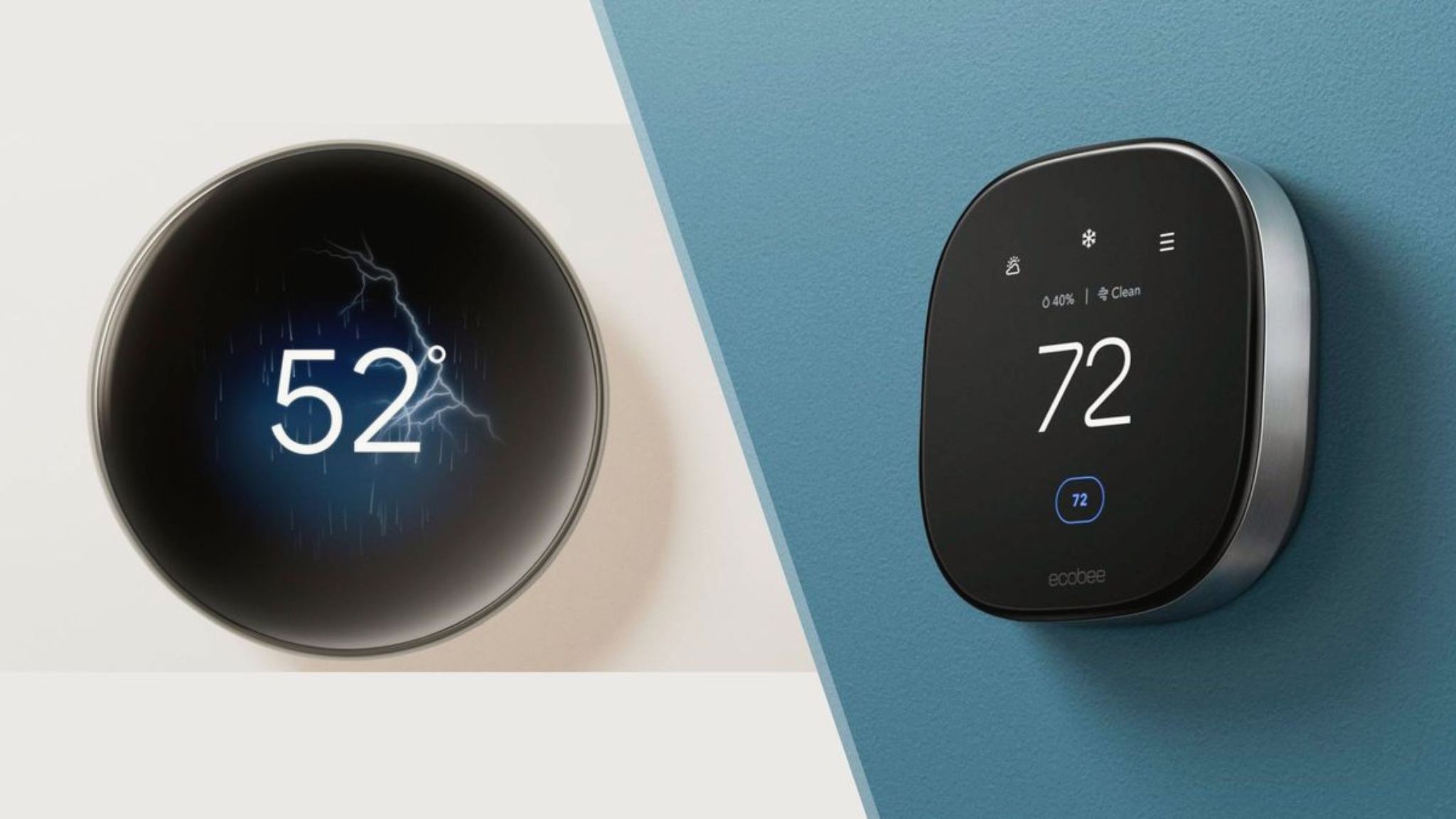
Google Nest and Ecobee are the two most popular smart thermostat brands we install across UAE homes. Both connect to Wi-Fi for app control, both save energy through scheduling and occupancy detection, and both work with Google Home, Amazon Alexa, and Apple HomeKit (on supported models). But they differ in how they learn your preferences, how they handle multi-room temperature balancing, and how they integrate into your broader smart home setup.
This comparison covers every model from both brands that we supply in the UAE, tested against the specific conditions that matter here: split AC and fan coil compatibility, performance in sustained 45+ degree heat, DEWA bill savings, and integration with the adapters required for most UAE AC systems.
Quick Verdict: Nest or Ecobee for UAE Homes
Choose Nest if you want automatic schedule learning that adapts to your routine without manual programming, deeper integration with Google Home, and the widest range of price points (from budget Nest Thermostat to premium Nest Learning 4th Gen). Nest is the better choice for households that use Google speakers and want a set-it-and-forget-it experience.
Choose Ecobee if you want a touchscreen interface, built-in Alexa voice control (on the Premium model), and the strongest multi-room temperature balancing through remote SmartSensors. Ecobee is the better choice for larger homes with uneven cooling across rooms and for households that prefer Amazon Alexa as their primary voice assistant.
Both brands work equally well with UAE AC systems when paired with the right adapter. Neither has an inherent compatibility advantage over the other in the UAE market.
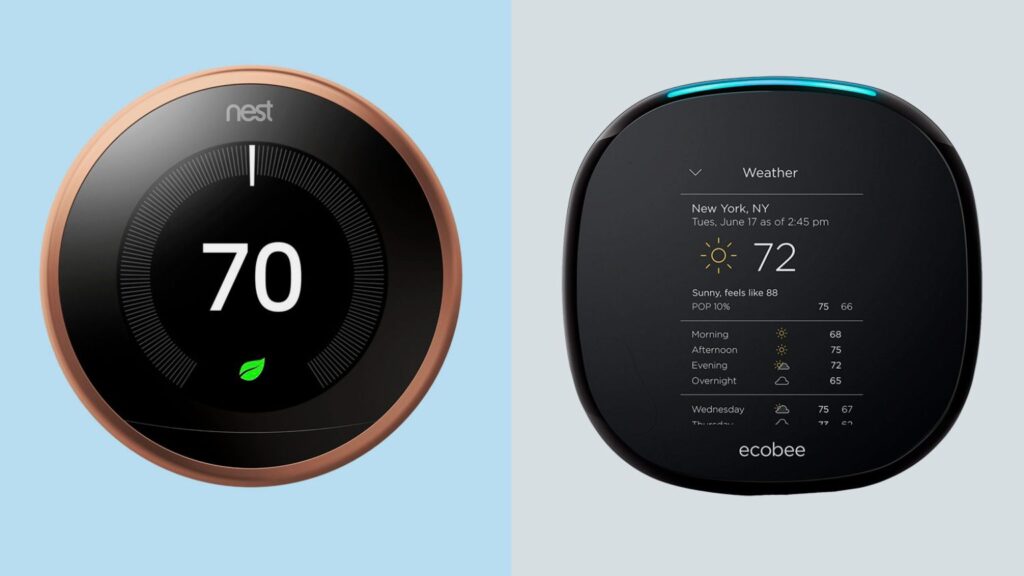
Full Comparison Table: Nest vs Ecobee Specs
This table compares the specific models we supply and install in the UAE. Specs are current as of 2026.
| Feature | Nest Thermostat (Budget) | Nest Learning 4th Gen | Ecobee3 Lite | Ecobee Premium |
|---|---|---|---|---|
| Price Tier | Budget | Premium | Mid-range | Premium |
| Display | Mirrored glass, crisp | 2.7″ borderless, curved glass | 3.5″ touchscreen | 3.5″ touchscreen |
| Adjustment | Side touch strip | Rotating dial | Touchscreen | Touchscreen |
| Build Material | Recycled plastic | Stainless steel | Plastic | Zinc alloy + glass |
| Auto Learning | No (Quick Schedule) | Yes (Smart Schedule) | No (guided setup) | No (guided setup + eco+) |
| Room Sensor | Not supported | 1 included in box | Supports SmartSensors (sold separately) | 1 SmartSensor included |
| Built-in Voice | No | No | No | Yes (Alexa built-in) |
| App | Google Home | Google Home | Ecobee app | Ecobee app |
| Google Home | Yes | Yes | Yes | Yes |
| Amazon Alexa | Yes | Yes | Yes | Yes (built-in + external) |
| Apple HomeKit | Yes | Yes | Yes | Yes |
| Farsight / Proximity | No | Dynamic Farsight (radar) | No | No |
| Humidity Monitoring | Basic | Yes (with display) | Yes | Yes + air quality |
| Humidifier/Dehumidifier Control | No | Yes | Yes | Yes |
| C-Wire Required | Depends on system | No (most installs) | No (Power Extender Kit included) | No (Power Extender Kit included) |
| Warranty | 1 year | 2 years | 3 years | 3 years |
| Energy Star | Yes | Yes | Yes | Yes |
For a comparison of Nest models only (budget vs 3rd Gen vs 4th Gen), see our dedicated Nest thermostat comparison guide.
Design and Daily Usability
Nest and Ecobee take fundamentally different approaches to how you interact with the thermostat on the wall.
The Nest Learning Thermostat 4th Gen uses a rotating stainless steel dial and a borderless curved glass display. You twist the outer ring to adjust temperature and press down to select options. The Dynamic Farsight feature uses radar to detect when you walk into the room and lights up the display with contextual information: current temperature and weather from across the room, humidity and air quality when you step closer. The interaction feels physical and intuitive. The Nest Thermostat (budget model) replaces the dial with a side-mounted touch strip where you swipe up or down and tap to confirm.
The Ecobee3 Lite and Ecobee Premium use a 3.5-inch touchscreen that works like a small tablet. You tap, swipe, and navigate menus directly on the screen. The interface is more information-dense than Nest. You can see your schedule, energy usage, sensor readings, and system status without opening the app. The Ecobee Premium adds a built-in speaker and microphone that functions as an Alexa smart speaker, so you can ask for weather, set timers, or control other smart home devices directly from the thermostat.
Which approach is better in practice? During our installations, we find that households with a primary Google Home setup gravitate toward Nest’s simpler interface and deeper Google integration. Households that already use Alexa devices tend to prefer Ecobee’s touchscreen and built-in voice assistant. Neither is objectively better. It comes down to which ecosystem you are already invested in and whether you prefer a physical dial or a touchscreen.
Scheduling and Learning: How Each Thermostat Manages Your AC
The biggest functional difference between Nest and Ecobee is how they handle scheduling.
Nest’s approach: automatic learning. The Nest Learning Thermostat (3rd Gen and 4th Gen) watches what temperatures you set and when, tracks when you leave and return home, and builds a personalized schedule automatically. After about a week of manual adjustments, the thermostat takes over. You stop touching it and it handles temperature changes on its own. The 4th Gen adds Smart Schedule, which can also suggest energy-saving tweaks through the Google Home app that you can accept or reject.
The Nest Thermostat (budget model) does not learn automatically. It uses a Quick Schedule guided setup where you answer questions about your routine, and it creates a basic schedule from your answers. You can adjust it manually afterwards.
Ecobee’s approach: guided setup with occupancy-based adjustments. Ecobee does not learn your temperature preferences the way Nest does. Instead, it uses a guided schedule setup where you define comfort and sleep temperatures and the times you are typically home or away. The intelligence comes from occupancy sensing: the thermostat and its remote SmartSensors detect whether anyone is actually in the house (or in a specific room) and adjust the AC accordingly. If your schedule says you should be home at 6 PM but nobody arrives until 8 PM, Ecobee keeps running in Eco mode until it detects occupancy.
Which works better for UAE lifestyles? If your household has a consistent daily routine (same work hours, regular patterns), Ecobee’s schedule-plus-occupancy approach works well and gives you more direct control over what happens when. If your schedule is irregular (shift work, frequent travel, family members coming and going at different times), Nest’s automatic learning adapts without you needing to reprogram anything. For a single-person apartment with a predictable routine, the difference is minimal. For a family villa with variable occupancy, Nest’s learning is the stronger advantage.
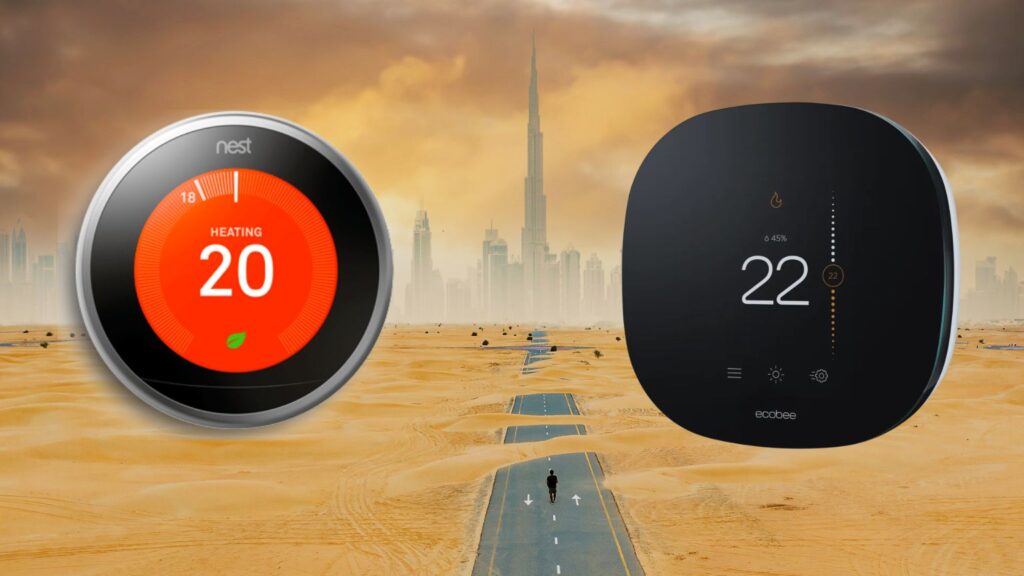
Room Sensors and Multi-Zone Comfort
Both Nest and Ecobee support remote room sensors that measure temperature away from the thermostat’s wall location, but they implement the feature differently.
Ecobee SmartSensors are included with the Premium model (one in the box) and sold separately for the Ecobee3 Lite. Each sensor measures temperature and occupancy (whether someone is in the room). You can set comfort profiles that prioritize specific sensors during different times of day. For example: prioritize the bedroom sensor during sleeping hours so the AC targets that room’s temperature, and switch to the living room sensor during evening hours. The thermostat averages or prioritizes readings based on your preferences and which rooms are occupied.
Nest Temperature Sensors are included with the Nest Learning 4th Gen (one in the box) and sold separately for the 3rd Gen. They measure temperature only (no occupancy detection). You can set the thermostat to prioritize a specific sensor’s reading, but the functionality is simpler than Ecobee’s. You choose which sensor the thermostat uses as its primary reference, and it targets that room’s temperature.
The standard Nest Thermostat (budget model) does not support room sensors at all.
For UAE homes specifically: Room sensors are most valuable in larger apartments and villas where sun exposure creates significant temperature differences between rooms. A south-facing living room in a Dubai Marina apartment can be 3 to 5 degrees warmer than a north-facing bedroom at the same time of day. Without a room sensor, the thermostat only reads the temperature where it is mounted on the wall, which may not reflect the room you actually want to cool. If uneven cooling across rooms is a problem in your home, Ecobee’s sensor system with occupancy-based room prioritization is the more capable solution.
UAE AC System Compatibility
Neither Nest nor Ecobee has an inherent compatibility advantage in the UAE. Both brands use standard 24V HVAC wiring and both require the same adapters for non-standard UAE AC systems. Here is the compatibility picture:
| UAE AC System Type | Nest Compatibility | Ecobee Compatibility | Adapter Needed |
|---|---|---|---|
| Ducted AC (24V wiring) | Direct connection | Direct connection | None |
| Fan coil unit (Empower/Tabreed) | Via adapter | Via adapter | DropAir iPanel |
| Wall-mounted split AC | Via adapter | Via adapter | DropAir Mini 6s |
| VRF/VRV system | Case-by-case | Case-by-case | Verify first |
One practical difference: the Nest Learning Thermostat 4th Gen does not require a C-wire in most installations, which simplifies wiring in older UAE properties. The Ecobee3 Lite and Ecobee Premium include a Power Extender Kit that provides an alternative to C-wire installation. Both approaches solve the same problem (powering the thermostat when no C-wire exists), just through different methods.
For a detailed guide on how these adapters work and which one you need, read our DropAir adapter compatibility guide.
Smart Home Integration: Google Home, Alexa, and HomeKit
All current Nest and Ecobee models work with Google Home, Amazon Alexa, and Apple HomeKit. The differences are in how deeply they integrate:
Google Home integration: Nest thermostats have the deepest Google Home integration because they are made by Google. You can include the thermostat in Google Home routines (for example, a “Leaving Home” routine that locks the door, turns off lights, and sets the thermostat to Eco mode with a single voice command or app tap). Ecobee also works with Google Home for basic voice control and status checks, but it does not support Google Home routines as deeply.
Amazon Alexa integration: Ecobee Premium has Alexa built into the thermostat itself, with a speaker and microphone on the unit. You can talk to it like an Echo speaker without any additional hardware. Nest supports Alexa through external Echo devices but does not have a built-in speaker.
Apple HomeKit: The Nest Learning 4th Gen, standard Nest Thermostat, and all Ecobee models support HomeKit. The Nest Learning 3rd Gen does not. If you use Apple’s Home app as your smart home hub, this is an important distinction.
For more on smart home connectivity and how thermostats communicate with your network, read our guide to how Wi-Fi thermostats work.
Energy Savings and DEWA Bill Impact
Both Nest and Ecobee are Energy Star certified, meaning they meet baseline efficiency standards verified by independent testing. Google claims the Nest Learning Thermostat can save up to 31% on cooling costs. Ecobee claims up to 26% savings. In practice, the actual savings depend more on how you use the thermostat than on which brand you choose.
Based on our installations across Dubai and Abu Dhabi, the typical DEWA bill reduction for a properly configured smart thermostat (either brand) is AED 50 to 150 per month during summer months. The savings come from three sources:
- Scheduled cooling. Running the AC at higher Eco temperatures (28 degrees) during working hours when nobody is home, and only cooling to comfort temperature (23 to 24 degrees) when someone is present.
- Home/away detection. Both brands detect when you leave the house (via phone location or occupancy sensors) and automatically switch to energy-saving mode. This catches the days you leave early, work late, or go away for the weekend.
- Night temperature adjustment. Setting slightly higher temperatures during sleep (25 to 26 degrees) when your body is less sensitive to warmth reduces overnight AC runtime without affecting sleep quality.
The difference between Nest and Ecobee on energy savings is negligible for most UAE homes. What matters far more is that the thermostat is configured correctly, that schedules are set to match your actual routine, and that Eco temperatures are enabled. For the full savings breakdown with DEWA tariff calculations, read our DEWA bill savings guide.
Which Should You Choose: Our Recommendation
After installing both brands across hundreds of UAE homes, here is our recommendation by scenario:
| Your Situation | Our Pick | Why |
|---|---|---|
| Studio or 1-bed apartment, budget matters | Nest Thermostat | Lowest cost, solid app control, Google Home integration |
| 2-3 bed apartment with uneven cooling | Ecobee3 Lite + SmartSensors | Best multi-room sensor system, occupancy-based balancing |
| Villa with variable family schedule | Nest Learning Thermostat | Automatic schedule learning adapts to irregular routines |
| Apple HomeKit household | Nest 4th Gen or Ecobee3 Lite | Both support HomeKit (3rd Gen Nest does not) |
| Heavy Alexa user | Ecobee Premium | Built-in Alexa speaker on the thermostat itself |
| Heavy Google Home user | Any Nest model | Deepest Google Home routine integration |
| Want maximum automation, minimal interaction | Nest Learning 4th Gen | Smart Schedule learns and adjusts without manual input |
| Want detailed control and information on screen | Ecobee Premium | 3.5″ touchscreen shows schedule, usage, sensor data |
If you are still deciding, our team can help. Send a photo of your current thermostat or AC setup on WhatsApp at +971 50 633 7803 and we will recommend the best option for your specific home. We also provide a free compatibility check to confirm that the thermostat you choose will work with your AC system before you commit to a purchase.
For a broader comparison that includes Honeywell alongside Nest and Ecobee, see our best thermostat brands guide for UAE. For help choosing based on your specific home type (apartment vs villa, split AC vs ducted), see our personalized smart thermostat buyer’s guide.
Frequently Asked Questions
Is Nest or Ecobee better for UAE apartments?
For most UAE apartments, either brand works well. The Nest Thermostat is the better budget option for studios and one-bedroom apartments. The Ecobee3 Lite is better for two to three bedroom apartments where room sensors help balance temperature across sun-facing and shaded rooms. Both require a DropAir adapter for split AC or fan coil unit connections.
Does Nest or Ecobee save more on DEWA bills?
The difference is negligible. Both brands save AED 50 to 150 per month during UAE summer months when properly configured with Eco temperatures and scheduling. The savings come from reducing unnecessary cooling during empty hours, not from the thermostat brand itself. What matters more is correct configuration and consistent use of energy-saving features.
Can I use Nest and Ecobee in the same house?
Yes. In villas with multiple AC zones, some homeowners install Nest on ducted zones and Ecobee on split AC zones, or mix brands based on room-specific needs. The downside is managing two separate apps (Google Home for Nest, Ecobee app for Ecobee). If unified app control matters to you, stick with one brand across all zones.
Which has better room sensors, Nest or Ecobee?
Ecobee’s SmartSensors are more capable because they measure both temperature and occupancy. Nest Temperature Sensors measure temperature only. Ecobee’s system can automatically prioritize the room someone is actually in, while Nest requires you to manually choose which sensor to prioritize. For homes with 3+ rooms and uneven cooling, Ecobee sensors offer a more practical solution.
Do Nest and Ecobee work with split ACs in the UAE?
Not directly. Both require a DropAir Mini 6s adapter to connect to wall-mounted split AC systems. For fan coil units (Empower/Tabreed), both need a DropAir iPanel. The adapter is the same regardless of thermostat brand. See our DropAir compatibility guide for full details.
Which thermostat has a longer warranty?
Ecobee offers a 3-year warranty on the Ecobee3 Lite and Ecobee Premium. Nest offers 2 years on the Learning Thermostat and 1 year on the standard Nest Thermostat. Ecobee’s warranty coverage is longer across the board.
Can thermostat.ae install both Nest and Ecobee?
Yes. We supply and install both brands across all seven Emirates, with same-day service in Dubai and next-day across Abu Dhabi, Sharjah, and all other Emirates. Our technicians configure the thermostat, connect it to your Wi-Fi, set up scheduling, and test all functions before leaving. See our installation cost guide for pricing.
Ready to decide? Browse the Nest Thermostat, Nest Learning Thermostat, and Ecobee3 Lite in our shop, or message us on WhatsApp at +971 50 633 7803 for a free compatibility check and personalized recommendation. We install both brands across Dubai, Abu Dhabi, Sharjah, and all other Emirates.
Call us directly at +971 50 633 7803 or visit our contact page to get started.